Mail merge through Amazon SES
Amazon SES sends email from your own AWS account, priced per thousand emails. With DearByDear Pro, a mail merge can go through it: each person’s email, made on your computer, sent by SES from an address on your domain. Setting up takes a verified domain, a key with five permissions, and leaving the SES sandbox.
With DearByDear Pro · From an address on your own domain · Researched from Amazon SES’s own pages, October 25, 2026
Before you start
- DearByDear Pro. $10 a month or $99 a year, with everything DearByDear has. Without it, you can add and check the account; a merge through it needs Pro: DearByDear Pro pricing
- A domain of your own, and its DNS. The From address must be on it, such as sarah@larkfield.example, never @gmail.com or the like: their policies would have the emails refused.
- An account at Amazon SES. No free plan for new accounts (AWS credits for new customers); $0.10 per 1,000 emails. As listed on October 25, 2026.
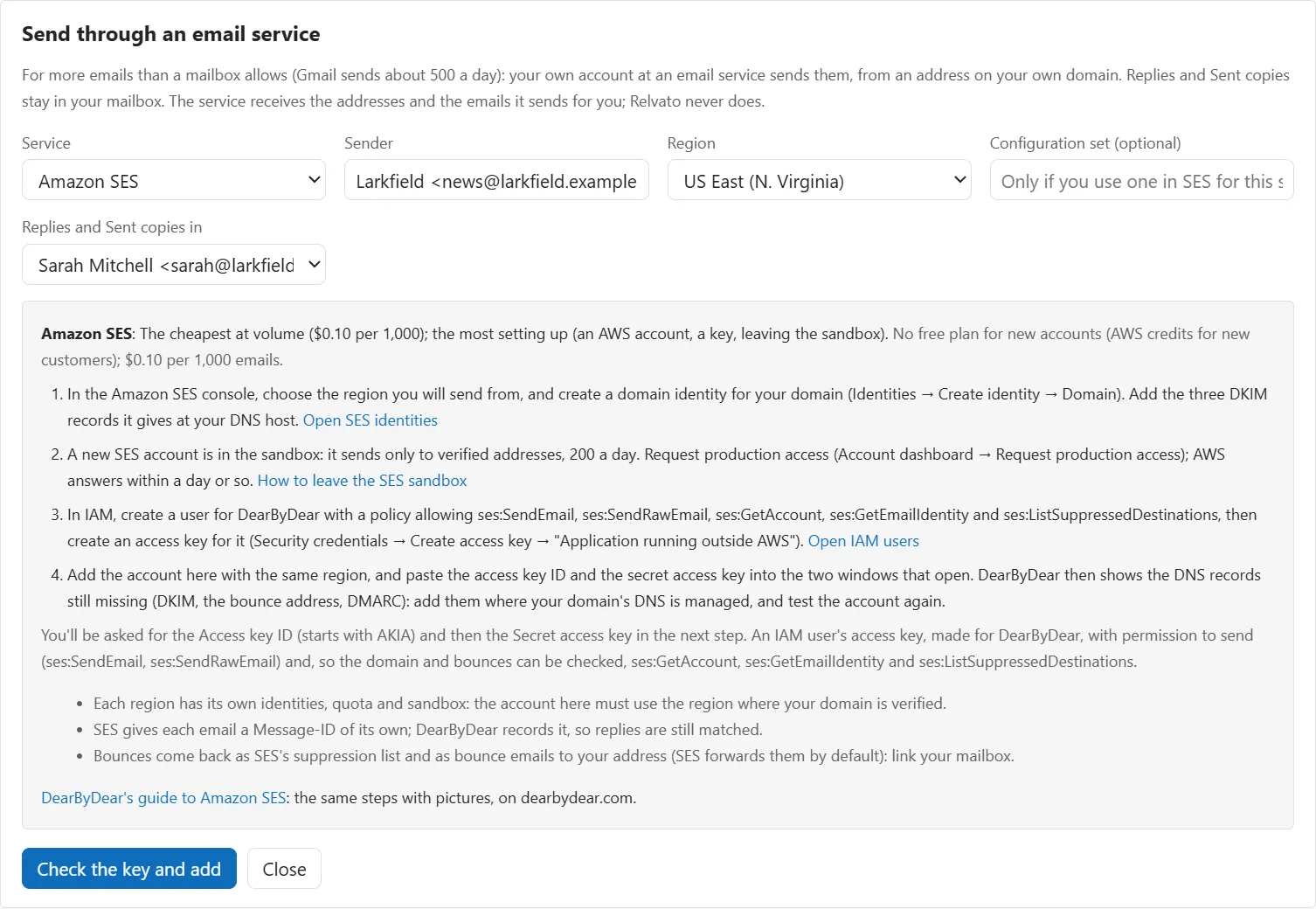
In DearByDear: Accounts → Add a mailbox → Send through an email service, then Amazon SES.
Connect Amazon SES, step by step
In the Amazon SES console, choose the region you will send from, and create a domain identity for your domain (Identities → Create identity → Domain). Add the three DKIM records it gives at your DNS host.
Open SES identitiesA new SES account is in the sandbox: it sends only to verified addresses, 200 a day. Request production access (Account dashboard → Request production access); AWS answers within a day or so.
How to leave the SES sandboxIn IAM, create a user for DearByDear with a policy allowing ses:SendEmail, ses:SendRawEmail, ses:GetAccount, ses:GetEmailIdentity and ses:ListSuppressedDestinations, then create an access key for it (Security credentials → Create access key → "Application running outside AWS").
Open IAM usersAdd the account in DearByDear with the same region, and paste the access key ID and the secret access key into the two windows that open. DearByDear then shows the DNS records still missing (DKIM, the bounce address, DMARC): add them where your domain's DNS is managed, and test the account again.
Good to know
- Each region has its own identities, quota and sandbox: the account in DearByDear must use the region where your domain is verified.
- SES gives each email a Message-ID of its own; DearByDear records it, so replies are still matched.
- Bounces come back as SES's suppression list and as bounce emails to your address (SES forwards them by default): link your mailbox.
What DearByDear does with it
| What | With Amazon SES |
|---|---|
| How each email goes | The whole email, as DearByDear made it, through SES’s API. |
| How replies are matched | SES gives each email a Message-ID of its own; DearByDear records it and matches replies by it. |
| Where bounces and complaints come from | SES’s suppression list, and the bounce emails SES forwards to your address. Hard bounces and complaints go on your Do-Not-Disturb list. |
| Open and click tracking | Off for each email. |
DearByDear’s servers never see your list, your emails or your key: each email goes from your computer straight to your account at Amazon SES, and the key stays in Windows’ credential store. Amazon SES sends the emails, so it handles each one, under your agreement with it.
Link one of your mailboxes
An email service has no Sent folder or inbox of its own for you. Link one of your mailboxes to the account (Accounts → the account’s actions → Linked mailbox…), and DearByDear puts a copy of each email in its Sent folder, reads the replies there, makes drafts there when you review first, and can tell whether an email interrupted by a crash went out. Without one, replies aren’t tracked, so automatic follow-up emails would also go to people who replied, and there are no drafts to review.
Other email services
Sources
Each provider’s own pages, read on October 25, 2026. If Amazon SES’s pages say something different now, theirs is right.